Getting Here
At 3 hours from Paris or Toulouse, 1.30 hours from Lyon, 1 hour from Marseille or Aix-en-Provence, near Arles and Avignon, discover the village Les Baux-de-Provence and the beautiful and famous Provence.
The village of Les Baux-de-Provence, perched on a spur of rock, has an incredibly diverse architectural heritage including an extraordinarily beautiful citadel that towers over the surrounding countryside. The exceptional decor brings memories of the past back to life, upholds traditions, is home to the art of the people who lived here and plays host to prestigious events.
Les Baux-de-Provence is a listed heritage site that has won titles such as “One of the Most Beautiful Villages in France.”
Click on the symbol  to discover the main places of the material heritage of Les Baux.
Standing on a spur of rock in the heart of the Alpilles, the Château des Baux covers an area of 5 hectares and is one of the most majestic natural and historic sites. A listed Historic Monument, the Castle offers a breathtaking panorama over Provence, from Aix to Arles and beyond.
Until the French Revolution, the town of Les Baux-de-Provence was the seat of a jurisdiction that was both royal and seigneurial, long headquartered in this building, which was constructed in 1499.
The rampart against which the buildings were built was pierced in the second half of the 19th century to allow the opening of the town’s current entrance.
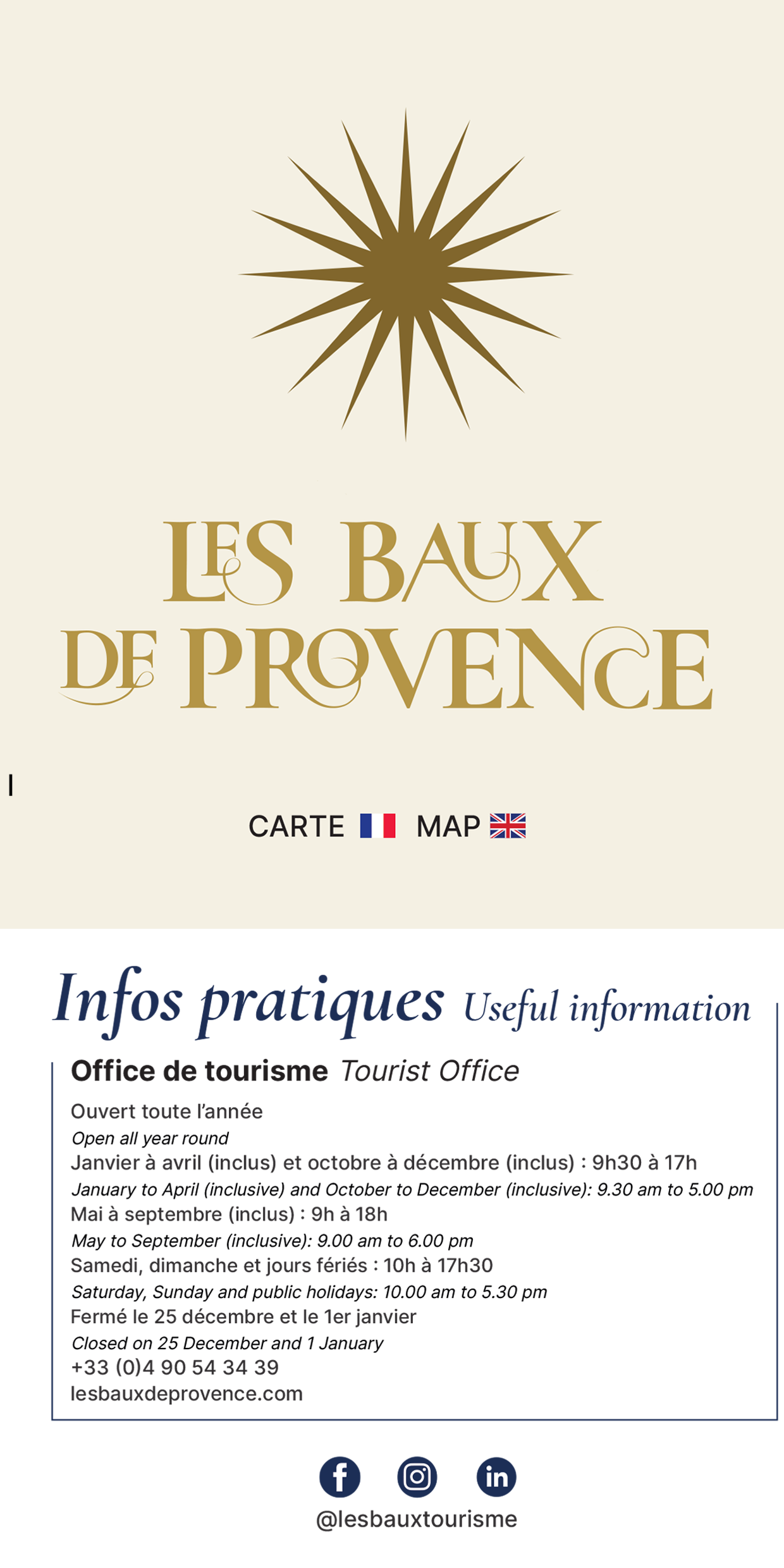
The Maison du Roy now houses the Tourist Office.
Labelled a Musée de France, the Musée des Santons brings together diverse collections: 17th- and 18th-century Neapolitan figurines, 19th-century church santons, and works by the renowned santon makers Carbonnel, Fouque, Jouve, Peyron-Campagna, Toussaint, Thérèse Neveu, Louise Berger, Simone Jouglas, and others.
A very large painting by Antoine Serra (1908–1995), depicting the Midnight Mass in Les Baux-de-Provence, completes these unique collections.
The only access to the village until 1866.
Rebuilt during the Renaissance, the Eyguières Gate was raised in the 18th century by the Princes of Monaco, who became Marquises of Les Baux in 1642.
The Grimaldi coat of arms, hammered away during the Revolution, can still be made out in a cartouche decorated with Baroque scrollwork.
It was restored once again in 2023.
This 16th-century residence has housed the Musée Yves Brayer since 1991.
The museum offers a retrospective of the painter’s work, a major figure in 20th-century figurative art, deeply connected to Mediterranean landscapes.
The vaulted ground-floor room, decorated with 17th-century frescoes, enriches the visit.
The museum also hosts temporary contemporary art exhibitions every year.
The Chapel of the White Penitents, built in the 17th century, charms visitors with its history and décor.
Restored in 1937, it pays tribute to the former Penitents and is dedicated to Saint Estelle.
Its bas-relief above the door, depicting two kneeling penitents, invites contemplation. Inside, a luminous fresco by Yves Brayer, painted in 1974, illustrates a Provençal Christmas.
This 12th-century church, partly troglodytic, is a gem of Les Baux-de-Provence.
Inside, the Manville family funerary chapel features a flamboyant Gothic vault, while a carved-out chapel houses the cart used during the Christmas ceremony dedicated to shepherding.
The modern stained-glass windows, designed by Max Ingrand and donated by Prince Rainier III in 1962, illuminate the building.
This Chapel was built in the 12th century by the guild of weavers and carders.
Undoubtedly the most enigmatic element of the village.
Opposite the Hôtel de Manville, the remains of a residence from 1571 bear the Calvinist inscription “Post Tenebras Lux” (“After darkness, light”), also the motto of Geneva.
This testimony of Protestant faith suggests the existence of a Reformed oratory in the 16th century, a time when Protestants were numerous in Les Baux.
The most beautiful Renaissance townhouse in the town of Les Baux-de-Provence was built in 1571 by a wealthy Protestant family, that of Claude de Manville.
The irregular façade, following the line of the main street, is widely punctuated by large mullioned windows.
The inner courtyard with arcades repeats the same arrangement of Renaissance openings. The restored building now houses the Town Hall.
The 16th century building was harmoniously restored by Louis Jou. Discover the finest works of this Master Typographer.
In the Vallon de la Fontaine, near the old washhouse, stands this elegant corner pavilion in Renaissance style, built by Jeanne de Quiqueran, wife of Honoré des Martins, Baron of Les Baux from 1568 to 1581.
It adorned a garden belonging to the Baux family, called the “Jardin du Comte” or “Verger du Roi”. Frédéric Mistral had a copy made for his tomb in Maillane.
Trémaie and Gaïe stand on the east side of the plateau, below the Castle remains.
In the Val d’Enfer, the monumental limestone quarries host immersive exhibitions.
Each year, a brand-new programme showcases the greatest names in the history of art.
Works by famous artists are projected to music onto 14-metre-high walls, creating a magical visual experience.
Visitors stroll through the heart of this spectacle, a true journey beyond time.
At 3 hours from Paris or Toulouse, 1.30 hours from Lyon, 1 hour from Marseille or Aix-en-Provence, near Arles and Avignon, discover the village Les Baux-de-Provence and the beautiful and famous Provence.
Maison du Roy, Rue Porte Mage,
13520 Les Baux-de-Provence
Tél. +33 (0)4 90 54 34 39
tourisme@lesbauxdeprovence.com
Opening hours
Monday to Friday: 9.30 am to 5.00 pm
Weekends & public holidays: 10.00 am to 5.30 pm
Closure: 25 December and 1 January